From our perspective, and I'm aware that what I'm about to write will evoke winces in Hillary Clinton supporters, it was a "long time coming". It took Clinton "too long" to "wake up to reality" and to "finally accept" what was "obvious to us all a long time ago".
I'm trying to step back and understand now how those thoughts and attitudes contributed to the gulf between Obama's supporters and hers.
What do you think was said between Barack Obama and Joe Lieberman in their three-minute heated discussion today in the Senate? Opinions vary. According to our crack team of daily kos lipreaders:
This will probably be my shortest diary to date, but I thought it was worth pointing out. Before the Puerto Rico primary, Hillary Clinton needed 79.24% of the remaining delegates (uncommitted + edwards delegates) in order to claim the nomination. She had 1876.5, and there were 303.5 remaining delegates. She needed 79.24% of them to reach 2117.
Now, after winning Puerto Rico, she has 1914.5 delegates, with 248.5 remaining. She now needs 81.49% of the remaining delegates. That's a higher percentage than before winning Puerto Rico. She got a lot today, but she didn't even get the bare minimum to hold steady. She fell further behind today - her nomination is even less likely than it was before.
I'm not much of a student of history, but I've picked up on a few things. I know that during the Cold War, we were all freaked out about nuclear war. Not just the possibility of the Soviet Union having an itchy trigger finger, but the United States being a bit unstable about it as well.
Years later I read about how that was a deliberate foreign policy strategy - brinksmanship and saber-rattling - to convince our enemies that we might just be crazy enough to do it. To get them to back down. And over time, it worked - helped along by an unexpectedly enthusiastic Reagan suggesting arms reductions beyond what was planned for. (His advisors hated him for that.)
Dick Cheney had his hand in that policy. A brinksmanship policy that freaked the hell out of everyone while it was happening, but that proved to yield positive results in hindsight (sort of).
What looked crazy at the time was actually rational in hindsight.
This is what gives me pause about this whole Iraq thing sometimes. All current explanations of Cheney rest on the assumptions of him being a power-mad and crazy recluse. It's as if no one can explain Dick Cheney without believing he's crazy.
Once in a while it's fun to go on flights of fancy.
We're in a period of time right now, right after the Pennsylvania Primary, where Obama's victory looks assured, and Hillary's looking rather desperate given her only strategy is to concede the elected delegates, hope for a dubiously-counted popular vote lead, and expect that to convince the unclaimed superdelegates to move towards her en masse.
The press is loving it. Democrats in disarray! John McCain content to let them tear each other down!
And in the meantime, state after state has record Democratic turnout, with almost no Republican activity. New Democratic voters are being manufactured by the thousands.
What do you call a good strategy when it's achieved? You call it a victory. I think we're all in agreement there. But what do you call a bad strategy, successfully achieved?
The answer to that is FAILURE. But to you, dear Traditional Media, it's still apparently a victory.
Let's take a quick general look at Hillary's presidential campaign. Is there one state outcome where she admits failure? Where she openly admits that they really needed a different outcome? I can't think of many, I can't really even think of one. According to her campaign, everything is going exactly to plan. And somehow her "plan" has resulted in her being far behind Barack Obama in elected delegates.
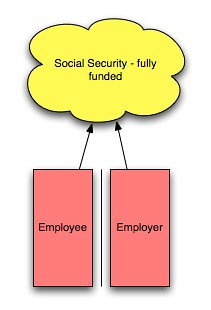
This particular factlet dives into the minutiae of social security projection details a bit, but it is also a hugely overlooked detail that could entirely change the perceptions of the health of social security.
"What is Hillary Cling-on Doing?" go the anguished cries. Here are my thoughts.
It's all too easy to ascribe ridiculous and irrational motivations to those we disagree with or don't understand. We have to remember that people act in accordance with their self-interest, and basically behave rationally as they define it.
My sense is that Hillary Clinton is looking out for her political future. And, again, I know the chorus of respondents here would say "but she's destroying her political future!" No. What she's destroying is what we would have her political future be.
Hillary knows at this point that she will most likely lose. That the odds are against her, and that her current approach is something of a hail mary.
Her choice is on how to lose. And this is where some aggravating aspects of gender politics come into play...
So I took a look at this table of unclaimed state super-delegates and brought out my spreadsheet.
I personally think it would be fair if a state's supers roughly broke out by the state's popular vote.
It's true that some states already far exceed that percentage (New York and Illinois, notably). There's no way the remaining supers in those states can make up for the percentage deficit, even if they all jump on the loser's side. So all you can do is collect the remainders.
That's what I did. I figured out what the equitable split would be for the supers, for all the states that have voted so far, excluding Michigan and Florida.. and Massachusetts, since the table was missing how many delegates are available. Then I allocated the remaining supers in a way that would come closest to approaching those percentages for each state.
Both candidates advantage depending on the state, but overall, Obama would make up the deficit a bit, by gaining on Clinton by the amount of (drumroll).... 38 superdelegates. Meaning, the superdelegate margin Clinton has over Obama would shrink by 38.
I've posted a few essays regarding my thinking of the three major candidates. The rough history is here - I liked it when Obama came to Daily Kos. I thought it showed courage and leadership, even though the response was less than heartening.
I came down pretty solidly in the Edwards camp, although I do remember being impressed by Hillary's warmth and likability in her debates - it didn't seem like she was trying to just come across as another man. That's a good step forward.
I was impressed by Barack in Iowa and wrote about it in the immediate aftermath - it hit the top of the reclist for a few hours there. I was thinking, maybe there was something to this unity stuff if it's actually what possibly helped him win Iowa.
But I was still in the Edwards camp, until I was shaken by Edwards' response to Hillary's emotion. I've gotten over that a bit, and am still impressed by Edwards, but... I'm still having to think... if Edwards doesn't make it, who am I going to support?
Every year on MLK Day I listen to a piece by still-living classical composer Joseph Schwantner, called New Morning For The World "Daybreak of Freedom".
It's a gorgeous piece of work. About twenty-seven minutes. It's for full orchestra and narrator, narrating excerpts of MLK's speeches. It's a beautiful recording, conducted by one of my favorite conductors, Leonard Slatkin.
This year I also discovered another great piece, by the jazz pianist Darrell Grant. The cd is named Truth and Reconciliation, and it was released in the last year. There is a piece on it, I Shall Believe, which is a loose cover of the Sheryl Crow tune, and it serves as a backdrop to more of MLK's speeches - the historical recordings weave in and out of the music.
Do any of you have other pieces of music or audio that you listen to on MLK Day?
I'm sure you've all heard of Hillary tearing up. Now, on the off chance that you haven't actually SEEN this "tearing up", this "emotional moment" that everyone is making such a big deal about, here's the video.
Barack Obama won tonight, and I take it as a lesson for the blogosphere/netroots, because he staked his approach on something that the more partisan amongst us have scoffed at for a few years. He convinced his opponents to give him power.
That's exactly what Edwards is against in 2008 (curiously, as he was not in 2004), and it goes counter to what many of the most visible of us have said on our front pages. That you can't expect your enemies to work with you. That you have to fight and oppose.
But Kucinich, Richardson, Biden... all were happy to make arrangements with Obama regarding their second-choice numbers, either directly or through implication. And the indication is that Obama's approach might work with Republicans, too, given his crossover appeal.
It's central to Barack's beliefs, too, as described in that youtube clip I saw on a diary earlier today, of Barack describing how being principled has an effect. (I'll include the link here if someone points me to it.)
It was primary season, 2004. Edwards was slightly intriguing to me but I was routinely caught between two impressions - thinking he was too smooth/suave, or thinking that his smoothness was actually a curse because it got in the way of seeing his sincerity.
I was a Dean fellow in 2004, and I also really liked both Clark and Edwards. I thought those three were the only three that were good at not accepting GOP terms for debate. One time I actually saw Edwards say the magic words, "I can't accept the premise of that question" in a debate, and I about jumped out of my chair cheering. It's hard to grasp just how hungry I was for that attitude back then.
It's that time of year when any diary that argues strongly in favor of a particular candidate can feel a little suspect. Are they part of the campaign? Are they simply sharing their feelings about the candidate, or are they in campaign mode, deliberately glossing over flaws, pumping up features, and generally indulging in talking points? It's hard to see what's real and what's not.
And so, just because I can, and because I'm hungry for some more honest opinions from people who haven't decided yet, I'm going to share my own impressions of each of the candidates right now, from my perch atop the fence. If you're also a fence-sitter like me, please weigh in with your thoughts.
Note that this is not the same question as "Who is your favorite candidate in the primary?" Don't just automatically go for your favorite. Think about who you think Al Gore would most likely endorse if he doesn't run for President himself. Tell us why.
(I'm deliberately leaving off a cutesy "No one! He's running! Or he'd BETTER!" poll option because it would be far too easy for y'all to click. Me too.)
I came across the following line in an opinion column by Joan Walsh:
Buchanan kept insisting Craig wasn't a hypocrite, preaching anti-gay "family values" while cruising for sex in men's bathrooms; Craig actually believes those values, the conservative pundit contends, but is just having a hard time living them.
Buchanan's quote tracks exactly with what I think is a major misunderstanding between the conservative and liberal mindsets. My thoughts on this after the jump.